
What is botox: a doctor explains
Botulinum toxin, better known as botox, is a drug that can be used in many ways. In cosmetic clinics, it is used to relax certain muscles in the face to soften or prevent lines and wrinkles.
Botulinum toxin is extracted from the clostridium botulinum organism under controlled conditions. Botulinum toxin type A has been found to be the most effective and is thus widely used. The drug can be injected into a muscle at the place where it contracts the most, causing a temporary blockage between nerves and muscles. This reduces the muscle's ability to contract. For some muscles, a single injection is sufficient, while others need several. Based on the anatomy and specific facial features of the person being treated, the doctor determines the dose and at which specific place an injection should be placed.
The effect of botox is visible after one to two weeks and lasts for about three to four months. The activity of the muscle then gradually returns. It is therefore advised to repeat the treatment after this time.
The upper half of the face
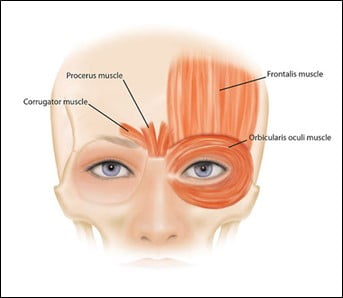
In the upper half of the face, three major muscles provide the most common lines. The following picture shows those muscles schematically.
Frown
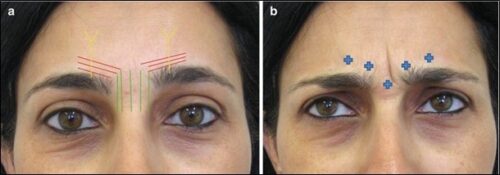
The frown is caused by movement of the muscles corrugator and procerus. The procerus is located exactly in the middle between the eyebrows and the corrugator runs both left and right above the eyebrows. These muscles cause the skin to contract in the line called the frown.
To treat the frown with botox, it is necessary to place five injections. One in the procerus muscle and four injections divided between both corrugator muscles. This way, these muscles are made less active, preventing them from drawing lines in the skin.
The forehead wrinkles
On the forehead lies a large muscle directly beneath the skin, known as the frontalis muscle. It is divided into two parts and is responsible for raising the eyebrows. When this muscle is overactive, forehead lines can become deep and may even remain visible at rest.
The frontalis muscle can be treated with a few botulinum toxin injections. The number of injections and the dosage vary per person and will be determined by the doctor based on your individual needs.

The crow's feet
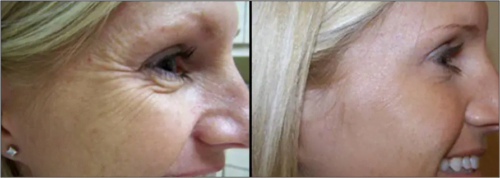
Crow's feet are caused by excessive contraction of the orbicularis oculi muscle. This muscle runs in a circle around the eye socket. Botox can be used to make this muscle less active. Two, three or four injections can be placed on either side of the eye socket, depending on the strength of the muscle and the wishes of the person being treated. An additional effect is that the eyebrow is subtly lifted with the relaxation of the orbicularis oculi. If desired, the eyebrow lift with botox alone can also be chosen.
If necessary, very low-dose and superficial injections can also be put under the eyes if the lines are concentrated mainly there.
The lower half of the face
The lower half of the face can also be treated with botox, this often involves muscles around the mouth.
Masseter
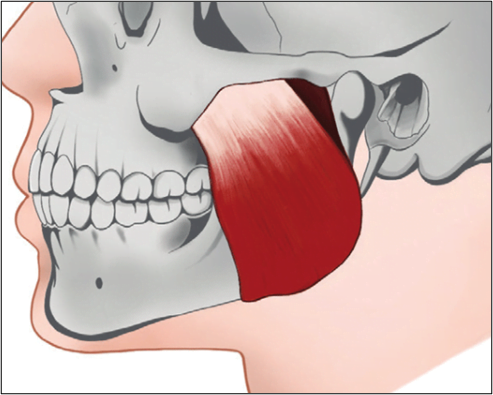
The masseter or large masseter muscle is located on either side of the cheeks and can sometimes provide a wider face shape. People who jaw clench or grit their teeth a lot can also benefit from treatment of these muscles with botox.
By placing one to two injections deep into this muscle, the muscle is calmed and the face can begin to look narrower. Symptoms of jaw clenching or grinding teeth also diminish or disappear completely.
Gummy smile
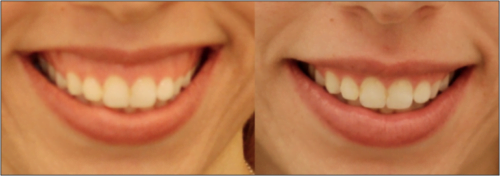
In some people, the upper lip lifts significantly when they smile, revealing more gum than desired. In such cases, injections can be administered into the LLSAN muscle (levator labii superioris alaeque nasi) to gently lower the upper lip to a level where only the teeth are visible when smiling.
The muscle runs alongside both nostrils toward the inner corner of the eye. One or two injections are placed just next to each nostril.
Hanging corners of the mouth
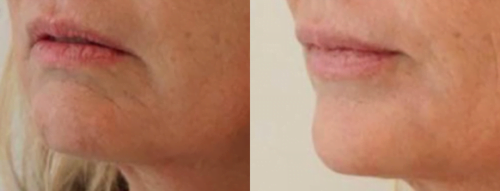
Precisely because botox has a muscle relaxing effect, we can overcome this problem by injecting botox at the corners of the mouth. This can help soften that stern look.
If there are (deep) puppet lines, botox may not be the best solution. If we want to fill wrinkles, it is better to use a filler . Of course our specialists are happy to think along with you and give you advice that suits your needs and face. Therefore, feel free to visit our clinic for a free consultation.
Smoking lines
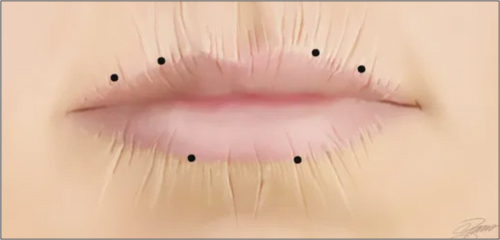
The fine lines just above the upper lip are also called smoker's lines or radial lip lines. These lines are most visible when someone makes a kissing movement, but can also remain in the skin. They are caused by contraction of the orbicularis oris muscle, which is the muscle that surrounds the mouth.
To relax these a little, a low dose of botox can be injected very superficially into this muscle. Again, if the lines are already too deep, it may also be decided to fill them with a filler.
Other treatments with botox
There are a number of other muscles and complaints that can be treated with botox. These include the muscles that cause bunny lines or dents in the chin. Migraines can also be treated by injecting botox into certain forehead or neck muscles, this can reduce symptoms for some people.
If a person sweats excessively under the armpits, botox can also be injected into the skin of the armpits. This temporarily disables the sweat glands in that area and reduces sweating in that area.
The Expert: Cosmetic Doctor & Surgeon

Dr Thanya Tha-In
KNMG Certified Cosmetic Physician & Surgeon
Dr. Tha-In has years of experience in facial surgery and has performed numerous procedures. She operates daily and knows exactly which treatment suits which needs or concerns.
SkinSurgery Bergschenhoek
Leeuwenhoekweg 4
2661 CZ Bergschenhoek
010- 310 56 20
SkinSurgery Tha Hague
Laan van Meerdervoort 677
2564 AC The Hague
070- 200 20 70

Be mindful of raising your forehead muscles after upper eyelid surgery

Why more and more thirty-somethings are opting for an upper eyelid correction with the Milan technique

Why do emotions change during the menopause? The role of the brain and gut

Ozempic, Mounjaro and the illusion of quick beauty

5x in a row Winner Clinic Awards - Best clinic in the Netherlands for Injectables